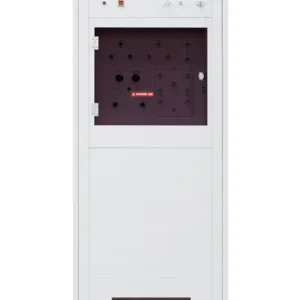
NoiseKen Lightning Surge Simulator LSS-720B2
0 out of 5
Availability: Available on backorder
SKU: NOI LSS-720B2
Categories: EMC Tester, Manufacturing Test Equipment, R & D
Brand: NoiseKen

NoiseKen Lightning Surge Simulator LSS-720B2
In stock
- Description
Description
This simulator simulates “high-energy induced lightning noise” induced in distribution lines and communication lines due to ground potential fluctuations caused by lightning strikes, and evaluates the resistance of electronic devices.
It is possible to check the dielectric strength due to induced lightning at a level that cannot be confirmed with the combination waveform required by the IEC standard.
Features
- Lightning surge simulator (Generator) conforming to JEC 210 / 212 Standard
- Maximum output voltage : 20 kV
Enables verifying dielectric strength against induced lightning surge which level cannot be available with the combination surge simulators - Maximum output current : 4000 A
Enables conducting testing for surge absorbers for their current handling capability - Enables observeing the output waveform only with an oscilloscope on hand and 1 / 10 voltage probes since 1 / 100 waveform check terminal is standard equipped
- Isolation transformer built-in so that the primary power input and EUT can be easily connected

Related Products
Manufacturing Test Equipment
NoiseKen Electromagnetic Field Visualization System EPS-02Ev3 (Small and low price version)
RSA306B can be used as standard for EPS-02EV3.
Features
EPS is a EMC/EMI debugging...
0 out of 5
EMC Tester, Manufacturing Test Equipment, R & D
NoiseKen FORD Standard Transient Pulse Generator ISS-T1321
Simulator to generate Transient Pulse as required in FORD's EMC standard (EMC-CS-2009)...
0 out of 5
EMC Tester, Manufacturing Test Equipment, R & D
NoiseKen Lightning Surge Simulator (AC500V/200A DC600V/200A)
Features
Compliant with IEC 61000-4-5 Ed.3 standard: ECE R10 is regulated at...
0 out of 5
EMC Tester, Manufacturing Test Equipment, R & D
NoiseKen Voltage Dip & Swell Simulator VDS-2002
Used to evaluate performance such as malfunctions and functional deterioration due to...
0 out of 5