
Home > Shop > Manufacturing > Production Line Testing > P9084D Desktop Arbitrary Waveform Generators
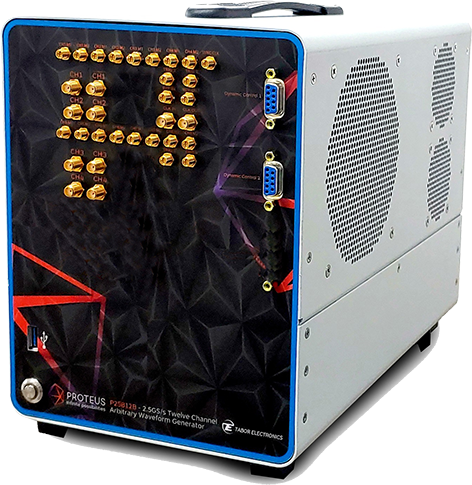

9GS/s 16Bit, 4GS Mem 4CH 16 Markers
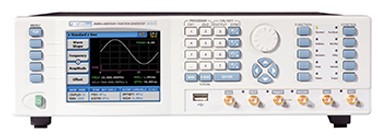
The Proteus P9084D, is a 9GS/s, four channel arbitrary waveform generator packaged in a 4U, half 19” dedicated chassis, offering technologically advanced options and configurations that integrate the ability to transmit, receive and perform digital signal processing all in a single instrument. The P9084D offers industry leading performance Including an innovative task oriented programming, real time data streaming, fast feedback loop for environment dependent waveform generation and user customizable FPGA for application specific solutions.
P9084D Desktop Arbitrary Waveform Generators
We are GST registered in New Zealand and we charge in New Zealand Dollars. Foreign-based customers please email us or call our Australian or New Zealand numbers below and we can manually process the sale without New Zealand GST. For Australian customers we can also invoice in AUD and you can pay into our Australian bank account to minimise bank fees and complexities.
Please note that you may be assessed for your countries duties and taxes on import as per your local regulations.
- Description
- Frequently Asked Questions
Description
- Four channel 9GS/s 16 bit AWG & AWT configurations
- 8GHz bandwidth, 2.7GS/s 12 bit digitizer option for feedback control system and conditional waveform generation
- Excellent phase noise and spurious performance
- Integrated NCO for digital up-converting to microwave frequencies
- Space efficient desktop platform, with USB 3.0, 10G Ethernet and thunderbolt high speed interfaces.
- Up to 16GS waveform memory with the ability to simultaneously generate and download waveforms
- Real time data streaming directly to the FPGA for continuous and infinite waveform generation
- User customizable FPGA for application specific solutions
- Innovative task oriented sequence programming for maximum flexibility to generate any imaginable scenari
What sample rate and resolution does the Tabor Proteus P9084D arbitrary waveform generator offer?
The Tabor Proteus P9084D runs at 9 GS/s with 16-bit resolution across four channels. It ships with 4 GS of waveform memory per channel and handles up to 16 markers per output.
That depth matters a lot in radar simulation and 5G test work, where both timing precision and amplitude accuracy have to be right simultaneously. Engineers in those fields will find the P9084D in Electrotest’s production line testing equipment range.
Can the Proteus P9084D transmit and receive signals at the same time?
Yes. The P9084D combines an AWG, a digitiser, and DSP in one box. An optional 2.7 GS/s, 12-bit digitiser lets the output waveform update in real time based on what the instrument is measuring from the device under test.
That feedback loop is what you need for adaptive signal testing and antenna characterisation, where playing a fixed pre-loaded waveform just does not cut it. Engineers pairing the P9084D with a spectrum analyser for full stimulus-and-capture setups can find compatible models in the same category.
What connectivity interfaces does the Tabor Proteus P9084D support?
The P9084D comes with USB 3.0, 10G Ethernet, and Thunderbolt as standard. Each interface connects directly to the FPGA, which is what lets the instrument stream waveform data in real time without stopping to reload.
The 10G Ethernet port makes a real difference when you are pushing large waveform files into the instrument repeatedly. Labs putting together full test systems around the P9084D can find complementary oscilloscopes, power supplies, and electronic loads in Electrotest’s R&D test equipment range.
What does “task-oriented sequence programming” mean on the Proteus P9084D?
Instead of playing waveform segments in a fixed order, the P9084D lets you break a test into discrete tasks that can loop, chain, or branch depending on incoming triggers or digitiser feedback. The signal never stops while this happens.
For anyone building radar pulse trains or frequency hopping tests, this is the feature that makes the instrument genuinely flexible rather than just fast. University and research labs will also find the P9084D listed under Electrotest’s advanced lab equipment range for science and engineering applications.
Is the Tabor Proteus P9084D suitable for microwave frequency applications?
Yes. The P9084D includes a built-in NCO that handles the up-converting, moving baseband or IF waveforms into the microwave range without needing a separate box to do it. Analogue bandwidth reaches 8 GHz.
That makes it practical for electronic warfare and satellite communications work, where you need to synthesise microwave signals directly. Engineers who need signal generators for lower-frequency telecom applications can find those at Electrotest, too.