PASCO Wireless Light Sensor, PS-3213

The Wireless Light Sensor provides live data for light level (lux), illuminance, UV Index, and color intensity.

Features

  • Wirelessly connects to computers, Chromebooks, tablets, and smartphones
  • Simply pair and go, no cables or adapters to manage
  • On-board memory enables the sensor to function as an independent datalogger
  • Variable sampling rate for short, precise experiments or lengthy, multi-day data collection.
  • Bluetooth connectivity and long-lasting coin cell battery
  • Indirect PAR measurements for biological studies

WHAT TO CONSIDER

See the Buying Guide for this item’s required, recommended, and additional accessories.

Get More Information

Availability: 1 in stock SKU: PAS PS-3213

PASCO Wireless Light Sensor, PS-3213

In stock

We are GST registered in New Zealand and we charge in New Zealand Dollars. Foreign-based customers please email us or call our Australian or New Zealand numbers below and we can manually process the sale without New Zealand GST. For Australian customers we can also invoice in AUD and you can pay into our Australian bank account to minimise bank fees and complexities.


Please note that you may be assessed for your countries duties and taxes on import as per your local regulations.


AUS:+61 2 913 96 981   NZ: +64 9 448 2600

Description

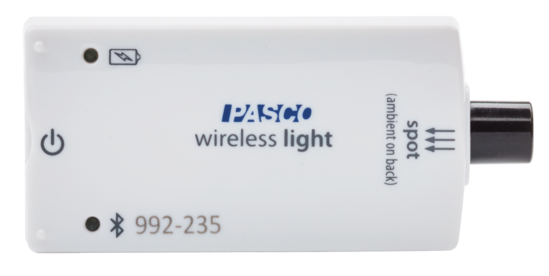
The Wireless Light Sensor features two separate apertures – one for ambient light measurements and one for directional light measurements. The ambient sensor measures illuminance and UV Index, while the spot (directional) aperture measures light level and color intensity. Our software displays the relative intensities of Red, Green, and Blue light, then sums them to determine the level of White light. PAR and irradiance are also available as calculated measurements within PASCO Capstone (version 1.8 or later) and SPARKvue software (version 2.6 or later).

Applications

  • Studying solar energy
  • Monitoring UV light levels
  • Reflection, absorption, and transmission of light through clear, opaque, and variously colored translucent mediums.
  • Investigating polarization and reflectivity
  • Modeling planetary motion
  • Verifying the inverse square law
  • Investigating insolation (solar radiation) and seasons

Related Products