Description
In this experiment, the resonance of a driven damped harmonic oscillator is examined by plotting the oscillation amplitude vs. frequency for various amounts of damping.
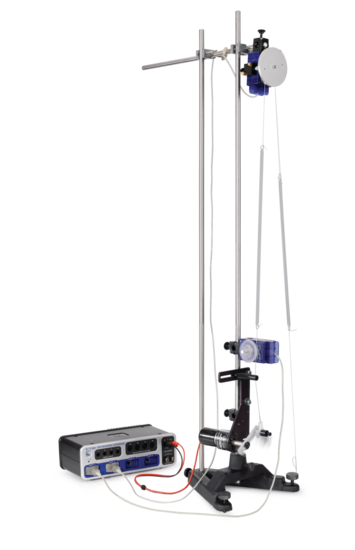
The oscillator consists of an aluminum disk with a pulley connected to two springs by a string. The angular positions and velocities of the disk and the driver are recorded as a function of time using two Rotary Motion Sensors. The amplitude of the oscillation is plotted vs. the driving frequency for different amounts of magnetic damping. Increased damping is provided by moving an adjustable magnet closer to the aluminum disk.
PASCO Advantage: The combination of PASCO Capstone software and the 850 Universal Interface has the power to sweep through the driver frequencies and the capability to plot the amplitude vs. the driver frequency in real time.
Concepts
- Resonance curves for an oscillator: amplitude vs. frequency
- Resonant frequency
- Period of a pendulum
- Effect of magnetic damping on shape of resonance curve
- Phase difference between oscillator and driver at low, resonant, and high frequencies