Description
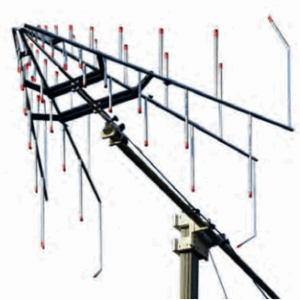
The stacked design helps to focus the directional pattern of the H-plane somewhat, resulting in a typical gain improvement of 2.5dB compared to an ordinary LP antenna. This is especially important for immunity testing, where a maximum field strength and a good field uniformity is required. The beam- width in the E-plane and the H-plane are nearly identical, providing an optimized illumination of the EUT with minimized ground reflection influence.
Further the cross polar rejection of the AXL-80 is excellent and the high and flat gain of about 9dBi over a broad frequency range is the main advantage of the AXL-80. Because of its physical dimensions the main application of the AXL-80 is in bigger anechoic chambers / test sites for radiated immunity tests and emission measurements. From its technical / mechanical design it is a double- stacked log.-periodic antenna, consisting of two excellent ordinary log.-periodic structures. For easy transport and storage it is possible to remove the rear elements of the antenna, which are fixed by fast links.