Description
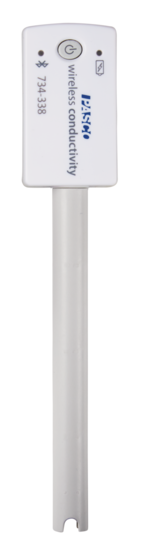
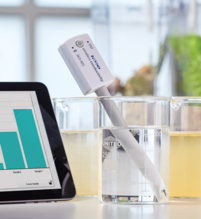
The Wireless Conductivity Sensor measures the electrical conductivity of an aqueous solution. It is ideal for investigating the properties of solutions, including total dissolved solids (TDS) for water quality inquiry. Because it is temperature compensated, calibrations are less frequent and can be applied across a range of temperatures. With a range of 0 to 20,000 μS/cm, this sensor can be utilized for chemical, biological, and environmental studies.
Teacher tip: To measure brackish or marine samples, perform a dilution until the measurement falls within the range, then multiply to determine sample conductivity.
Applications
- Water quality investigations
- Performing condumetric titrations
- Investigating solution properties
- Diffusion of ions through membranes
- Differences between ionic and molecular compounds
- Comparing strong and weak acids
How It Works
Conductance is the reciprocal of resistance. In this case, the Wireless Conductivity Sensor determines the conductance of an aqueous solution by measuring the current flowing through the circuit created when a voltage is applied to a 2-cell electrode submerged in the solution. The electrode cell is constructed from insulating material with embedded with pieces of platinum that are placed at a fixed distance apart to serve as sensing elements. Because conductivity is dependent on temperature, the Wireless Conductivity Sensor includes a built-in temperature compensation.