
Home > Shop > Science & Engineering Education > Sensors > Wireless Motion Sensor, PS-3219
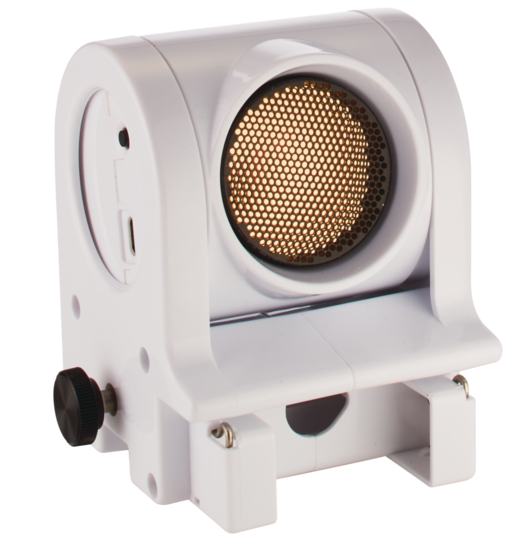
The Wireless Motion Sensor uses ultrasound to measure the position, velocity, and acceleration of objects.
Features
- Measures position, velocity, and acceleration
- False Target Rejection Technology produces cleaner data
- Clips directly to PASCO Dynamics Tracks
- Rod clamp for mounting
- 180° pivoting head
- Rechargeable lithium-ion battery
- Bluetooth® or USB connectivity
WHAT TO CONSIDER
See the Buying Guide for this item’s required, recommended, and additional accessories.
Wireless Motion Sensor, PS-3219
We are GST registered in New Zealand and we charge in New Zealand Dollars. Foreign-based customers please email us or call our Australian or New Zealand numbers below and we can manually process the sale without New Zealand GST. For Australian customers we can also invoice in AUD and you can pay into our Australian bank account to minimise bank fees and complexities.
Please note that you may be assessed for your countries duties and taxes on import as per your local regulations.
- Description
Description
The Wireless Motion Sensor connects via Bluetooth or USB to your device, and uses ultrasound to measure the position, velocity, and acceleration of objects. This enables students to take turns measuring themselves, while the class observes their motion materializing as a graph in real time. The sensor can detect objects ranging from 15 cm to 4.0 m away, and without cables to get in the way, students can explore handheld and ceiling-mounted applications.
Applications
- Measure the motion of moving objects
- Explore the relationship between position, velocity, and acceleration
- Measure objects in freefall
- Measure how air resistance affects falling objects
- Investigate frames of reference
- Investigate the Conservation of Energy and Momentum
- Simple harmonic motion
- Seafloor mapping
How It Works
The Wireless Motion Sensor uses echolocation, similar to a dolphin or bat. In order to determine the distance to an object, an ultrasonic pulse is emitted from the sensor. The sensor listens for a signature ‘echo’ which reflects off the object’s surface. The object’s distance is calculated by determining the elapsed time between the ultrasonic pulse and detected echo, then, this value is used with the speed of sound to calculate the object’s distance. Measurements of velocity and acceleration are derived algorithmically using numerical methods. This provides a balanced approach to calculating numerical derivatives, which reduces noise and minimizes smoothing effects on high frequency peaks.