

Home > Shop > On Sale, Clearance & Rental > On sale > Wireless Temperature Sensor, PS-3201
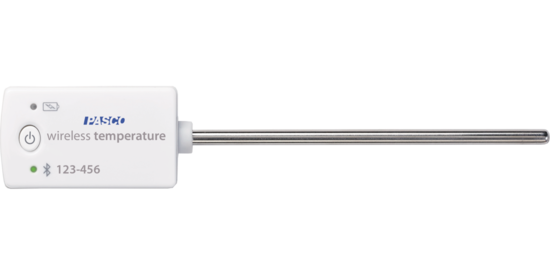
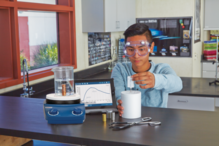

The Wireless Temperature Sensor is a general-purpose sensor found in many science labs. With a rugged, waterproof design, and long-lasting battery, students can spend mre time collecting data and less time dealing with equipment.
Features
- Simply pair and go, no cables or adapters to manage
- Variable sampling rate for capturing small, fast changes or experiments that run for hours, days, or weeks
- Features convenient Bluetooth wireless connectivity and long-lasting coin cell battery
- Logs temperature data directly onto the sensor for long-term experiments
- Dust, dirt, and sand-proof and water resistant (IP-X7 certified)
WHAT’S INCLUDED
1x Coin cell battery
WHAT TO CONSIDER
See the Buying Guide for this item’s required, recommended, and additional accessories.
Wireless Temperature Sensor, PS-3201
We are GST registered in New Zealand and we charge in New Zealand Dollars. Foreign-based customers please email us or call our Australian or New Zealand numbers below and we can manually process the sale without New Zealand GST. For Australian customers we can also invoice in AUD and you can pay into our Australian bank account to minimise bank fees and complexities.
Please note that you may be assessed for your countries duties and taxes on import as per your local regulations.
- Description
Description
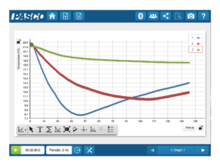
Welcome to the modern thermometer. Now, students can access real-time data that continuously monitors, logs, and plots temperature measurements on nearly any device. When lab-time ends but the experiment continues, students can set the sensor to log data autonomously for days or weeks, then download it for analysis later. This durable, wireless sensor features a stainless steel temperature probe for the most demanding of applications, as well as a battery that lasts over a year*. It can be used in a wide array of experiments and activities because it measures small, but significant temperature changes produced by chemical reactions, convection currents, and even skin temperatures.
Note: The rugged sensor housing/handle is rated for temperatures of -10 ºC to 40 ºC. This means it cannot be subjected to the same extremes as the stainless steel probe. For extremely low or high temperature applications we recommend the Electrode Support to keep the sensor in the proper position during experiments.
*Battery life is based on typical usage in a secondary or college lab.
Perform These Experiments
- Explore freezing and melting points
- Study endothermic and exothermic reactions
- Measure the energy content of food
- Monitor environmental conditions and water quality
- Observe inter-molecular forces and evaporative cooling


